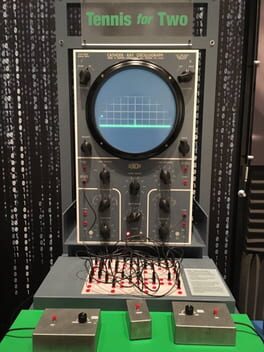
Tennis for Two
Tennis for Two is often credited to be the world's first video game.
63Wit Score
Details
DeveloperWilliam Higinbotham
ReleasedOctober 18, 1958
StatusReleased
Genres
Themes
Platforms
Modes
Wit-Index Intelligence
Community Score
Mixed Reception63/100
About This Game
In 1958, a physicist at Brookhaven National Laboratory named Willy Higinbotham cobbled together a novel entertainment device for the lab's annual public open house—an analog computer, a pair of makeshift controllers, and a five-inch oscilloscope screen that would collectively birth one of gaming's earliest experiences. The resulting creation presented visitors with a stark, two-dimensional side view of a tennis court, where players manipulated rotating dials and buttons to serve and volley against an unseen opponent, their racquet angles determined by the precision of their controller inputs. What began as a simple effort to add some levity to a scientific showcase would go on to be recognized as a pioneering work in interactive entertainment, drawing crowds eager to participate in this curious new form of play.