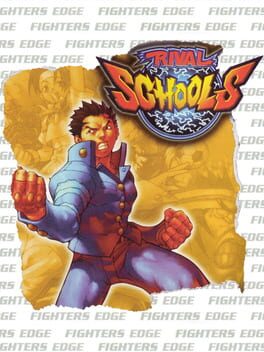
Rival Schools: United by Fate
The main fighting game is best described as a polygonal Marvel vs. Capcom game, with some notable differences. Control wise, the game varies from other Capcom fighting games by only having four buttons (two punches and two kicks, which is closer to the SNK game format) rather than the standard six. A player chooses a team of two characters, and fights against another two character team. The actual fights, however, are one-on-one fights, with the partner only participating by being called in when a player has enough 'vigor' for a Team Up attack, done by pressing a punch and kick button of the same pressure. The Team Ups would be some kind of double team attack by the character and partner, or (for most female characters' Team Ups) would heal the main character or give them more vigor. After the end of a round, a player (win or lose) has a choice to fight the next round with the partner from the previous round, or to keep their main character in play. The 'vigor' meter (essentially a super meter) could go up to 9 levels, with Team Ups costing two levels and super moves from a single person all costing one level of vigor. Much like the Marvel vs. Capcom games, launchers can be done that allow air combos to be performed, with all characters having universal low and high launchers.
The game also had a few defensive techniques.
Tardy Counters acted much like Alpha Counters from Street Fighter Alpha, allowing a player to immediately counter-attack from a blocking position. However, the restrictions on Tardy Counters are very lax; any hard normal, special or super attack can be used to Tardy counter (Alpha counters are only limited to certain special moves for each character), and Tardy Counters do not cost any extra vigor to perform (Alpha Counters required at least a level of Super Combo gauge to do).
Attack Cancels allowed a player to cancel an incoming hit simply by timing their own hit with the attack, which would cancel out both attacks (though it does not nullify the remaining hits of a multi-hit move). Also, one additional level of vigor is awarded.
82Wit Score
Details
DeveloperCapcom
ReleasedNovember 17, 1997
StatusReleased
Genres
Themes
Platforms
Modes
SeriesRival Schools
Wit-Index Intelligence
Community Score
Highly Recommended82/100
About This Game
The story of Rival Schools introduces the player to a Japanese city called Aoharu City, where several local schools are the victims of unknown attacks and kidnappings of students and staff. The various characters in the game set out to find who is responsible for the attacks on their school, with the cut-scenes and fights portraying their interactions with the other schools and among themselves. Eventually, the story reveals that an elite school in the city, Justice High, is responsible for the attacks. The player's team eventually faces off against Raizo Imawano, the principal of the school, and first boss of the game. If certain requirements are met during the fight against Raizo, the story would continue as the player would then head into a true final boss fight against Hyo Imawano, Raizo's nephew and the true mastermind behind the events of the game.
The structure of the single player game of Rival Schools varied depending on how characters were selected. If two characters from the same school were selected (with a few exceptions), single-player would play in a progressing story with fights predetermined beforehand and each fight preceding and ending with short 2D cut-scenes to explain the story. If two characters from different schools were chosen, the single-player mode would instead play similar to other fighting games, with the player's chosen team fighting against random teams of opponents before facing the boss. In the arcade, character selection was initially limited to selecting two characters from the same school and free selection of any character was accessed through time; the PlayStation versions, which included all characters unlocked by default, had no such restrictions.